
In short
The best tender software for Belgian public contracts depends on where you lose time. The process breaks down into three parts: finding tenders, writing the bid and submitting the file. Submission happens on the platform named in the tender specifications, which for most Belgian procedures is BOSA e-Procurement, Belgium's official public procurement platform. Around it, there are commercial tools. TenderWolf is strong at finding and interpreting tenders across Europe. Sequesto focuses on recurring RFPs and questionnaires. TenderRender combines tender alerts through a direct connection with BOSA e-Procurement with analysing the tender specifications, writing the bid, filling in forms such as the ESPD and reviewing against the award criteria. Below you can read what each tool is for and how AI helps you win more public contracts in Belgium.
This comparison is published by TenderRender; we make one of the tools discussed. It is a qualitative comparison of areas of use based on publicly available information, not an independent test and not a complete market overview. Website information checked on 9 September 2026, article updated on 6 October 2026.
Where the time goes
As an illustration, take an SME that wants to bid for a maintenance contract from a local authority. A bid rarely gets stuck at the upload; the work is in the week before. Someone reads eighty pages of tender specifications (the "bestek" in Belgium) to decide whether bidding makes sense. The selection criteria, exclusion grounds and award criteria are spread across the administrative provisions, the technical section and the annexes. Answers to earlier tenders sit in folders, mailboxes and people's heads. And the submission deadline does not move.
Software steps in at three points:
- Finding and selecting: following publications, filtering and quickly deciding whether to take part.
- Writing and substantiating: building the bid around the award criteria, with evidence for each answer, and filling in the forms.
- Submitting: formally lodging the file according to the rules in the tender specifications, on e-Procurement.
Doing point 2 well does not cover point 3. Nor the other way round.
Three tools side by side
1. TenderRender
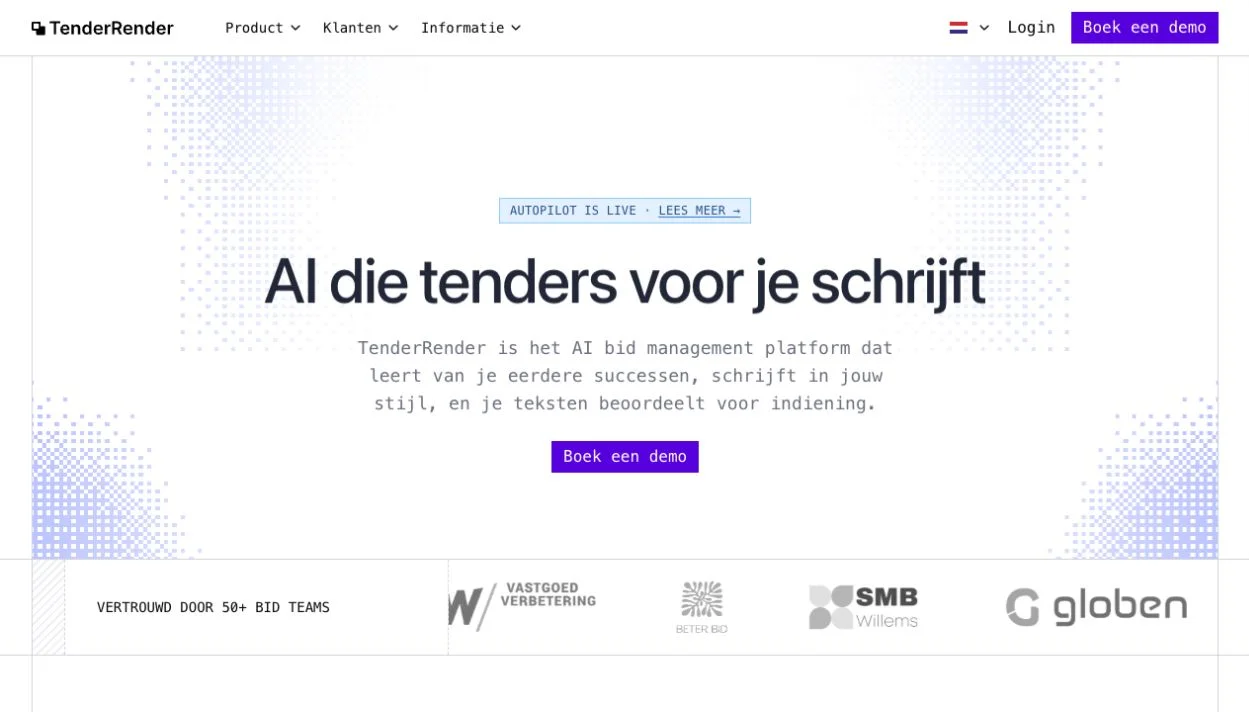
Website of TenderRender, captured on 9 September 2026.
What it is: TenderRender is an AI platform for finding public tenders and preparing bids. New Belgian publications come in through a direct connection with BOSA e-Procurement. The AI gives each tender a match score from 1 to 5 with an explanation of why it fits, and you get a daily email with the new matches. A tender you find elsewhere, you add manually. The AI then analyses the tender specifications, writes bid texts from your own past bids and verified company data, fills in forms and assesses your text per award criterion. You see the source for every statement. Checking and submitting stay with your team. If you also look across the border, you will find Dutch and German tenders in the same environment.
Strengths: analysis of the tender specifications with source citations, bid texts from your own material, completed forms and a review that points out, per award criterion, where you are leaving points on the table. ISO 27001 certified, GDPR compliant and no training on your data.
Points to note: not a procurement platform; you submit on the platform named in the tender specifications. The user interface is in Dutch, English and German; the AI can analyse French-language tender specifications.
Who it is for: teams that see enough tenders but improvise the writing week from scratch every time.
2. TenderWolf
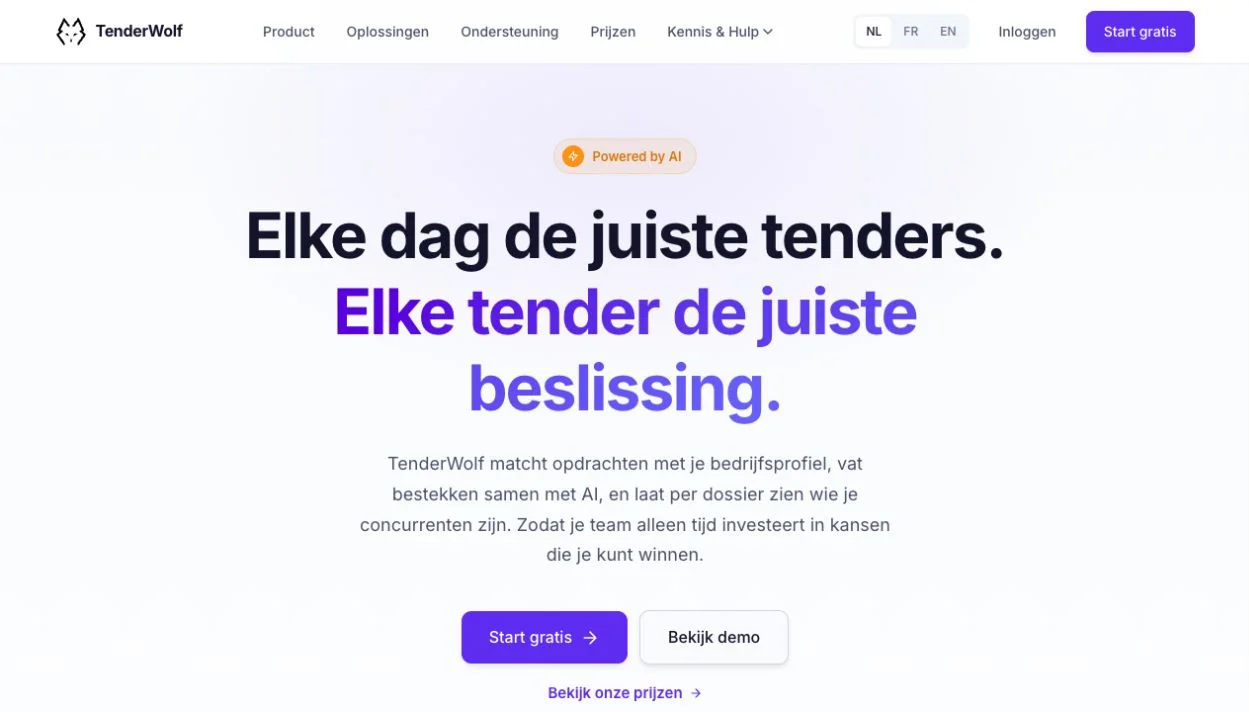
Website of TenderWolf, captured on 9 September 2026.
What it is: TenderWolf is a Belgian platform focused on finding opportunities: matching publications from many European sources to your profile, AI summaries of tender specifications and insight into past awards and competitors (tenderwolf.com).
Strengths: broad European coverage, early alerts and fast triage. A summary helps with a first decision without reading the full tender specifications. Transparent matching and public prices.
Points to note: test during a demo whether the matching recognises your lots and niches. TenderWolf mentions writing support as a direction of development; check what is live today.
Who it is for: organisations that do not get enough relevant tenders on the table, or that bid in several European countries.
TenderWolf or TenderRender? The question is which decision you want to improve. "Which tenders do we bid for?" is TenderWolf's territory. "How do we make this bid stronger?" is TenderRender's territory. Both send alerts for Belgian tenders; after the decision to bid, TenderRender takes over the analysis, writing and review work. They can also work side by side. See also TenderWolf alternatives.
3. Sequesto
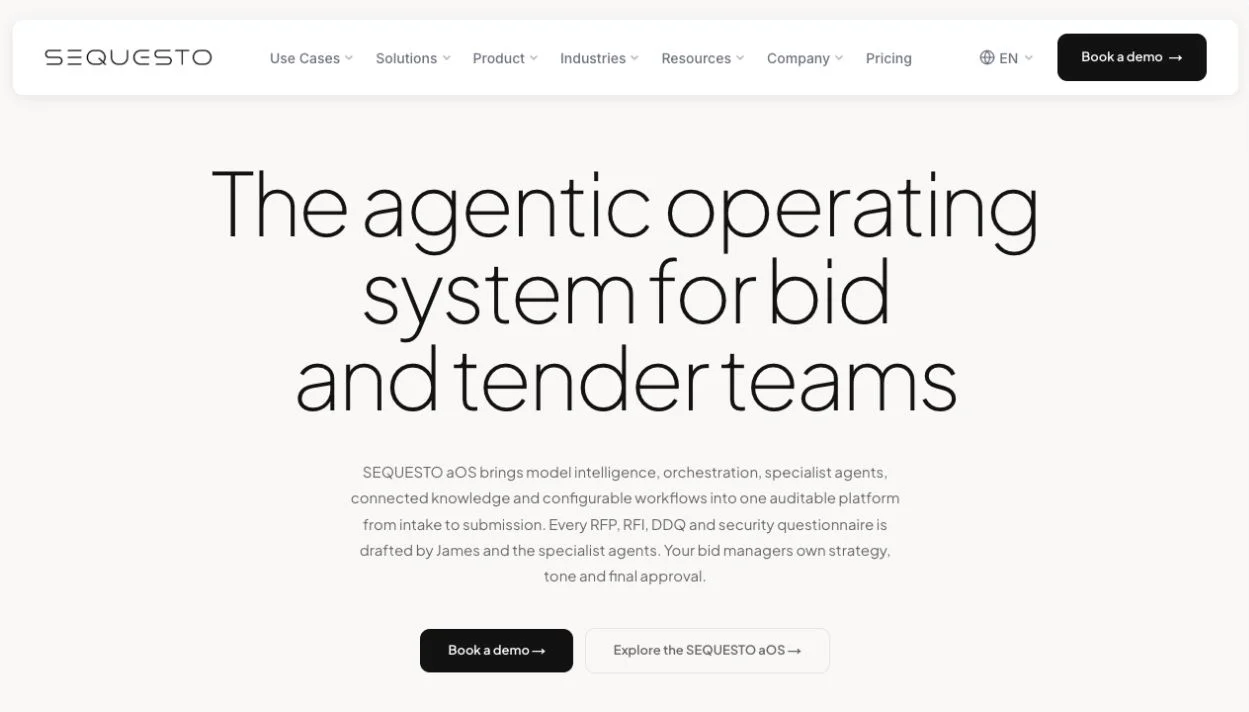
Website of Sequesto, captured on 9 September 2026.
What it is: Sequesto, based in Ghent, is AI for RFPs, tenders and questionnaires, with connected knowledge sources, configurable workflows and final human approval (sequesto.com).
Strengths: useful when the same questions keep coming back in different forms and several colleagues need to contribute and sign off sections, including in several languages.
Points to note: ask how the knowledge base stays up to date; an answer library goes stale without an owner.
Who it is for: bid teams with a lot of repetitive question-and-answer work across sectors, often international.
Comparison in one table
| Tool | Core role | Question to ask during a demo |
|---|---|---|
| TenderRender | BOSA alerts with match score, analysing tender specifications, writing the bid, filling in forms and reviewing | Does the tool extract all award criteria from our tender specifications, including those in the annexes? |
| TenderWolf | Matching European publications to your profile, with AI summaries and insight into competitors | Does the matching recognise our lots and niches? |
| Sequesto | Answering RFPs, tenders and questionnaires from connected knowledge sources | Who keeps the knowledge base up to date and who signs off? |
How does AI help you win more public contracts in Belgium?
AI does not win tenders for you. It helps at three points where Belgian bidders often lose points or time.
Better selection. A match score with an explanation shows faster which tenders really suit you. Less time on tenders you would not win anyway means more time for the bids that matter.
Not missing a requirement. A bid that is not compliant stands no chance, however good the content. AI puts the formal requirements, selection criteria and award criteria from the whole set of tender specifications on one list, with the source alongside.
Sharper writing against the award criteria. A review that reads your text the way the evaluators do points out where a criterion has not been answered sufficiently or where a promise has no evidence. In practice, that is where you win points.
Analysing tender specifications with AI
Belgian tender specifications usually consist of administrative provisions, a technical section and annexes, sometimes with a bill of quantities or inventory. TenderRender reads the whole set and answers the questions you ask for each part: which exclusion grounds and selection criteria apply, how much each award criterion weighs, which documents you need to add and what the submission deadline is. You can set up your own standard questions that are answered automatically for every new set of tender specifications. Every answer has a source citation, so one click shows you where it is in the tender specifications.
If there are ambiguities or contradictions, the AI also drafts questions for the clarification round. You can read how to phrase those questions well in fill in tender forms and clarification questions faster with AI; the approach works just as well for the Belgian clarification round.
Filling in the ESPD and other forms
A Belgian public contract comes with forms: the European Single Procurement Document (ESPD, called UEA in Belgium), the tender form, the inventory and sometimes the contracting authority's own declarations. Each time, the same data: company registration number, turnover, insurance, references.
TenderRender fills in PDF and Word forms, such as the ESPD and the tender form, from your verified company data and previously completed forms. Anything the AI cannot back up with a source stays open and goes on a checklist. For yes/no declarations, such as the exclusion grounds in the ESPD, it can enter a provisional answer; that answer also goes on the checklist, and you confirm it before signing. A known place of signing and today's date can be filled in too. Signatures and initials always stay empty. You can read how that works step by step in how TenderRender fills in your tender forms.
Note: for contracts below the European thresholds, the tender specifications do not always require an ESPD. What you need to submit is determined by the tender specifications of the contract itself.
BOSA e-Procurement: the official platform
BOSA e-Procurement is the official Belgian platform for public procurement. It replaces the former separate applications e-Notification and e-Tendering. TenderRender helps you find relevant tenders and prepare your bid; BOSA is the channel on which procedures are published and on which you submit.
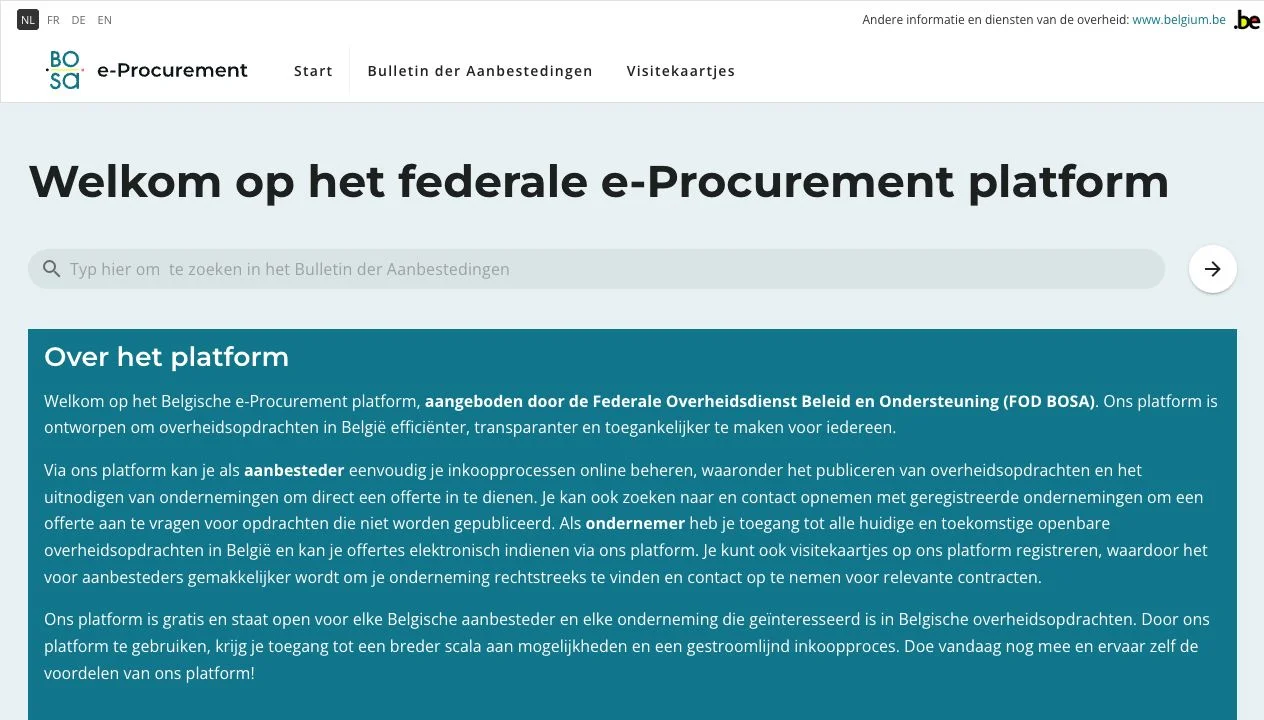
Website of BOSA e-Procurement, captured on 9 September 2026.
For procedures on this platform, companies register, search publications, save searches with notifications and submit their bid (bosa.belgium.be).
How to choose
Start with your own bottleneck. Do you see too few tenders, or is the writing week chaos every time? That determines which category you buy first.
Test with real tender specifications. Take a bid you won or lost last year and let the tool process it during the demo. Does it extract all award criteria, including those in the annexes? What happens with French-language tender specifications?
Look at provenance and confidentiality. Where is your material stored, who has access, and can you trace a generated paragraph back to the source document it relies on? Without provenance, proofreading stays as slow as writing it yourself.
Count on a final human check. Prices, commitments, references and submission remain human work. Judge a tool on how well it prepares that check.
Frequently asked questions
What is the best tender software for Belgium?
That depends on your bottleneck. For finding tenders across Europe, TenderWolf is a specialist. TenderRender is built for analysing the tender specifications, writing the bid, filling in forms and reviewing against the award criteria, with a direct connection with BOSA e-Procurement for tender alerts. Test both with tender specifications you know.
Does tender software replace BOSA e-Procurement?
No. If your tender runs through that platform, registration and submission of your bid happen there. A writing tool supplies documents; a person submits them in line with the procurement documents.
Can AI fill in the ESPD for me?
Largely. TenderRender fills in the ESPD and other forms from your verified company data and previous forms. Anything that cannot be backed up with a source stays open on a checklist, and you always sign yourself.
Do I need both a search tool and a writing tool?
Not necessarily. TenderRender sends alerts for Belgian tenders itself via BOSA. Many SMEs also get their tenders through existing channels and lose most of their time on writing. Start there. If you also follow below-threshold contracts and your market with a tool such as Tender Experts, add TenderRender for the bid.
Is this an independent ranking?
No. This page is TenderRender's and compares areas of use, not performance. Test every tool yourself.
Read more
- TenderWolf alternatives [2026]
- Tender analysis with AI: read tender documents in minutes, not days
- How TenderRender fills in your tender forms
- Fill in tender forms and clarification questions faster with AI
- Writing tenders with AI: a step-by-step plan
Curious what your tender specifications look like when criteria, formal requirements and deadlines are on one list? Take a look at TenderRender



